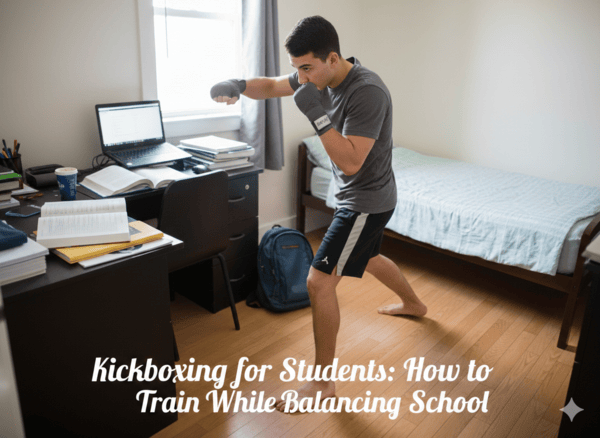
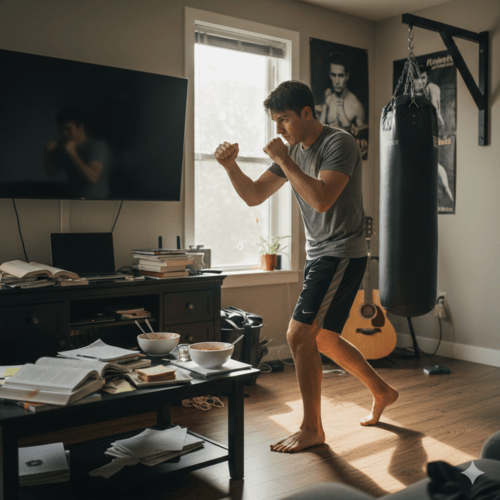
Balancing university life with martial arts is a notorious challenge. For many students, the combination of dense assignments, part-time work, and tuition stress makes the trek to the gym feel nearly impossible.
Consequently, many find themselves forced to take a hiatus from the mats. However, missing classes does not have to mean falling behind.
By utilizing short study breaks for intentional shadowboxing and technique drills, students can maintain their “fight IQ” and physical conditioning without ever leaving their residence. In fact, this approach allows for consistent progress even during the most demanding exam seasons.
Table of Contents
The "Dorm-Room" Kickboxing Routine
This 40-minute routine requires zero equipment and focuses on the fundamentals that keep a fighter sharp during the off-season.
| Round | Exercise | Duration |
| 1-2 | Shadowboxing (Warm-up) | 2 x 3 Minutes |
| 3-4 | Dutch Drill Combinations | 2 x 3 Minutes |
| 5 | Leg Checking Technique | 5 Minutes |
| 6 | Push Kick Defense Visualization | 5 Minutes |
| 7 | Lead Teep Kick Development | 5 Minutes |
| 8 | Rear Push Kick Power | 5 Minutes |
| 9 | Jab-Cross-Hook-Cross Flow | 5 Minutes |
| 10-11 | Shadowboxing (Cool Down) | 2 x 3 Minutes |
Kickboxing for Students: How to Train When You Have No Time
1. Shadowboxing Warm-Up
When a student cannot make it to the gym for months at a time, shadowboxing serves as the ultimate tool for retention. Starting with two 3-minute rounds allows the body to warm up while the mind focuses on fluid movement.
Beyond the physical benefits, it serves as an excellent stress reliever, clearing the mind of academic pressures. Furthermore, it ensures that the combinations taught by coaches remain instinctive and smooth.
2. Solo Dutch Drill Combinations
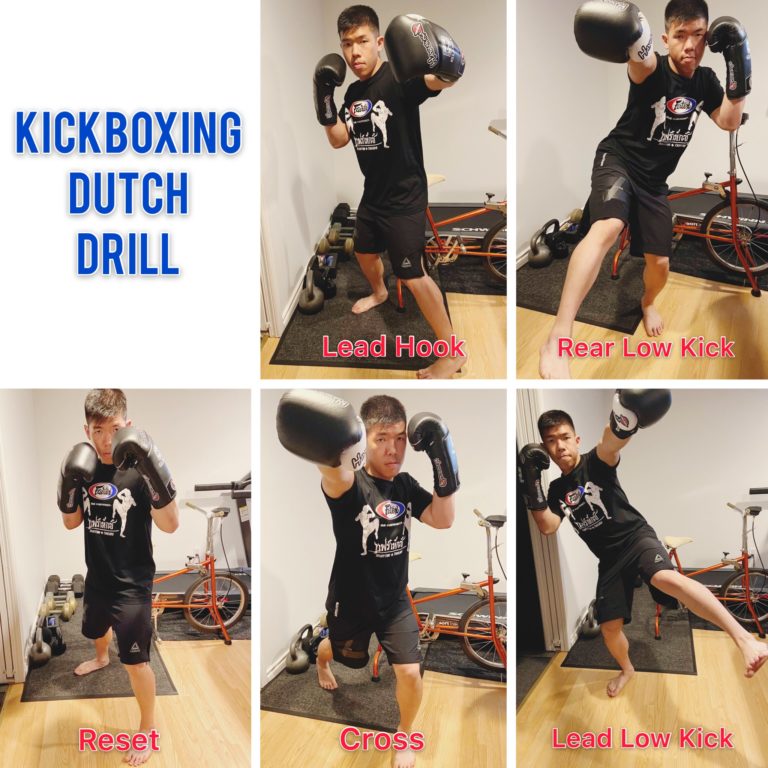
“Dutch Drills” are usually performed with a partner; nonetheless, they remain highly effective when practiced solo to build muscle memory. The Basic Dutch Sequence:
Lead Hook
Rear Low Roundhouse Kick
Reset
Cross
Lead Low Roundhouse Kick
By practicing this at home, the transition back to live sparring becomes seamless once the semester ends. As a result, the student avoids the “rust” that typically follows a long break.
3. Mastering the Leg Check
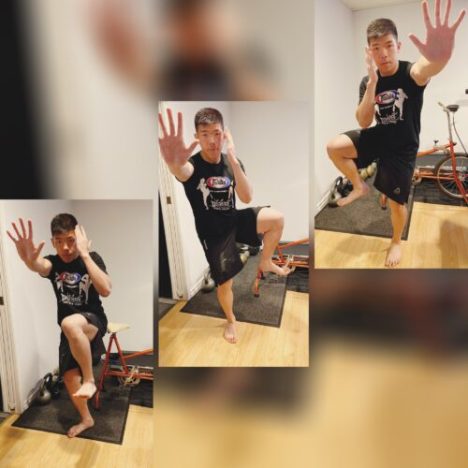
Defense is often the first thing to decline during a training hiatus. Since partner training isn’t an option at home, visualization is key. For instance, a student can practice the leg check by imagining an opponent’s low kick and reacting instantly.
Specifically, this involves lifting the shin and flexing the foot to “harden” the block. This solo repetition significantly improves reaction time for future sparring sessions.
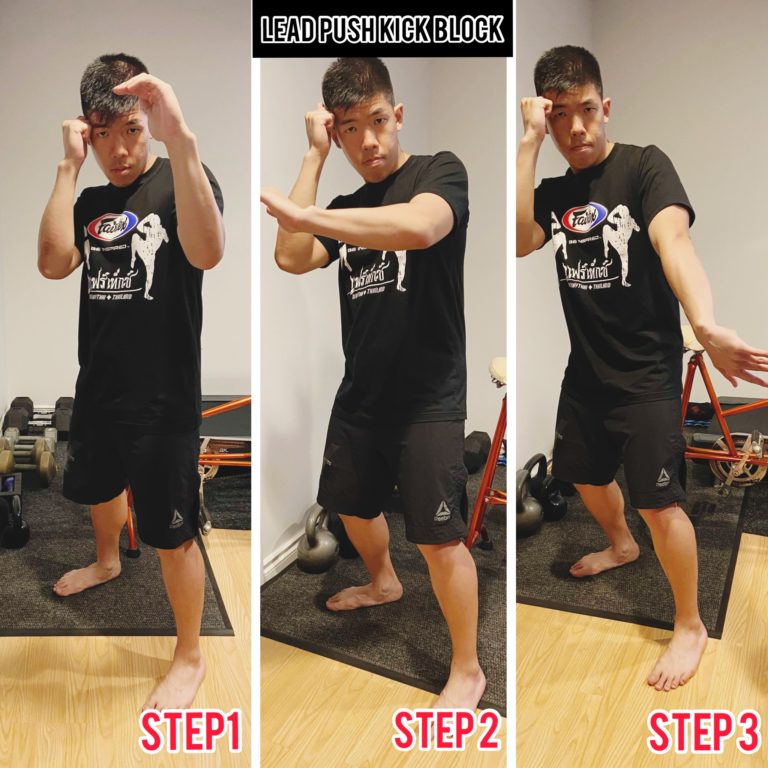
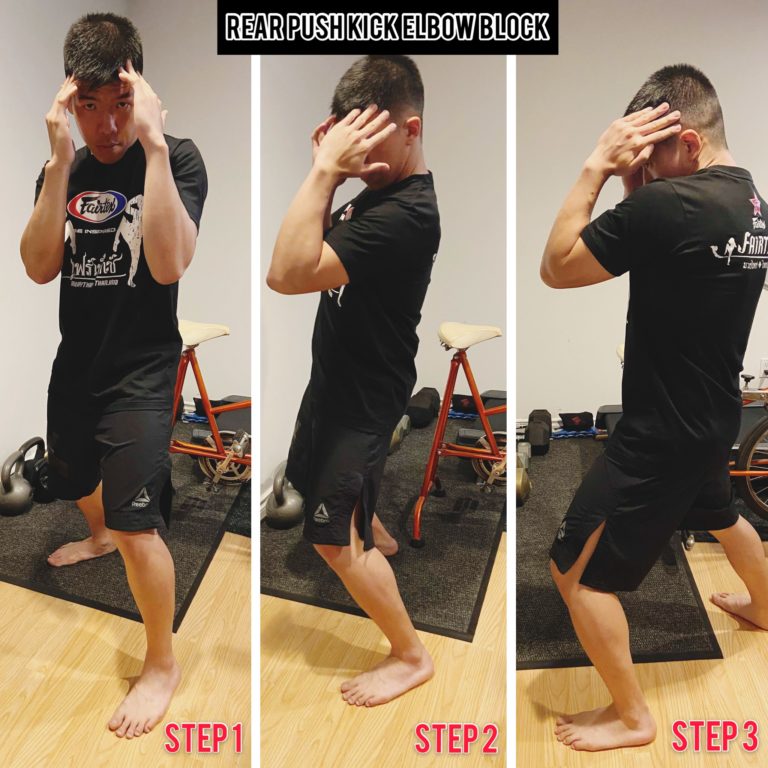
4. Visualizing Push Kick Defense
Similarly, defending against a Teep (push kick) requires precise timing and visual focus.
Lead Leg Defense: Use the lead hand to sweep the foot away as it approaches.
Rear Leg Defense: Use the lead elbow to knock the kick toward the right side. Practicing these motions in the mirror helps a fighter internalize the angles needed to deflect an opponent’s force.
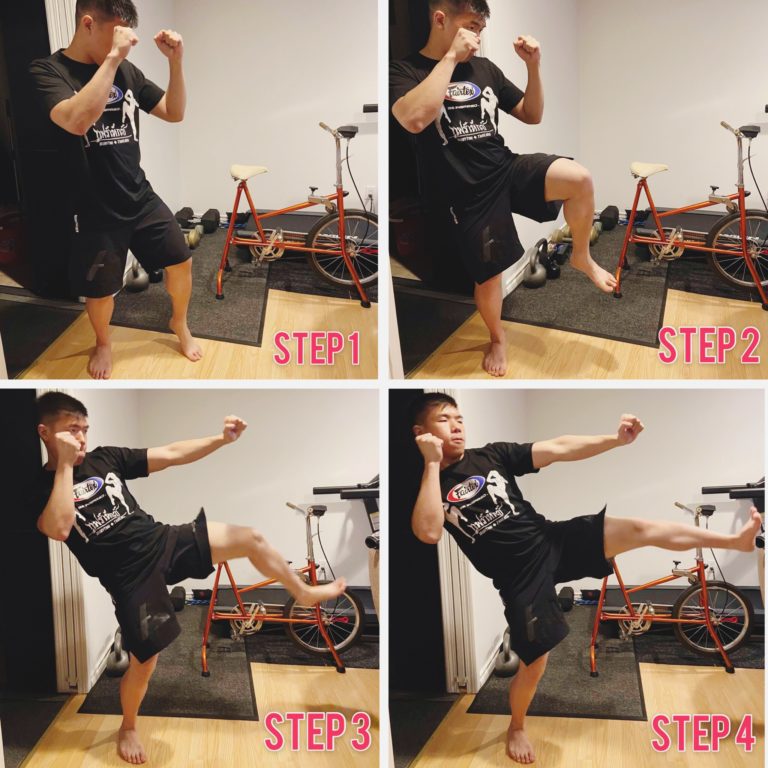
5. Developing the Teep (Front Kick)
The Teep kick is a deceptive strike. While it looks simple, the form is difficult to master.
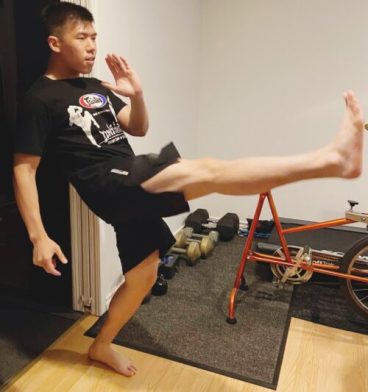
Students can use a wall for balance while practicing the chambering of the knee and the “stabbing” motion of the ball of the foot. Since it is an essential tool for keeping aggressive opponents at bay, refining the motion during study breaks is time well spent.
6. Strengthening the Rear Push Kick
In addition to the lead Teep, the rear push kick is a vital power move. Repeatedly repping this out at home strengthens the hips.
Consequently, this increased hip engagement allows a fighter to create massive distance between themselves and their opponent once they return to the gym.
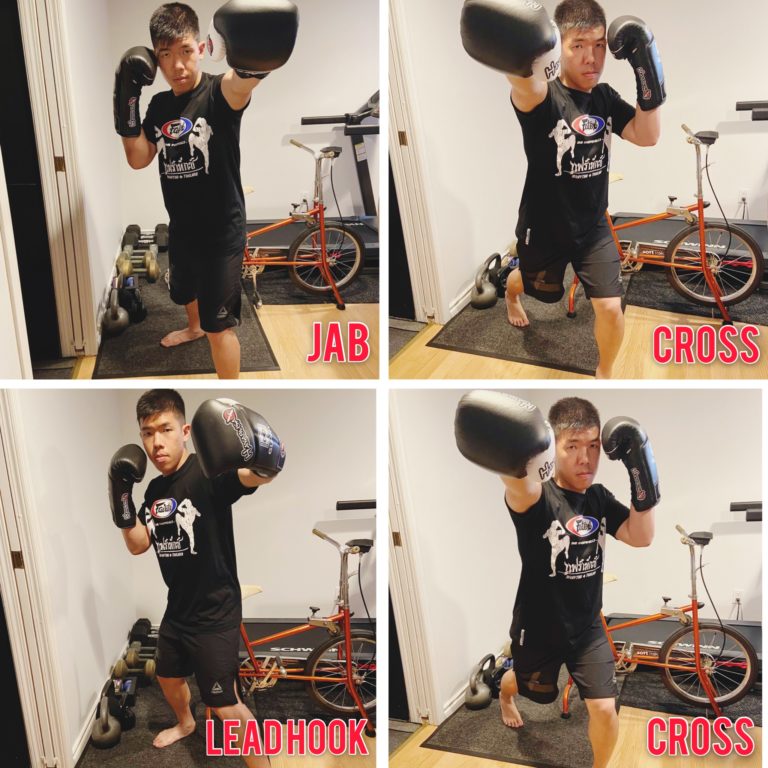
7. Refining the "bread and butter" Combo: Jab-Cross-Hook-Cross
Kicking is vital; however, a fighter must never neglect their hands. Devoting five minutes to this classic four-punch combination keeps the knuckles aligned and the shoulders snappy.
Moreover, maintaining proper form ensures that punches remain effective and powerful, even in the absence of a heavy bag.
8. Final Shadowboxing Flow
The session concludes with two final rounds of shadowboxing. This is the time to integrate everything—the checks, the Teeps, and the Dutch combinations—into a natural rhythm.
It doubles as a cardiovascular finisher, ensuring the student’s “gas tank” stays full for their eventual return to the mats.
Conclusion
Training while in school is ultimately about commitment over convenience. While the library may be the priority, taking 40 minutes to sharpen the basics is a productive way to manage stress and stay sharp.
By the time graduation or summer break rolls around, the student who trains at home will find themselves steps ahead of those who stepped away from the sport entirely.
Got more questions about balancing kickboxing training with school? Drop a comment below or send me a message. I’m happy to help!
5 Kung Fu Techniques You Can Apply to Kickboxing
As I mentioned from the “5 Reasons Why Transitioning From Kung Fu to Kickboxing is a Good Change” journal, I...
Read MoreBoxing | 12 Ways To Stay In Shape During School
Boxing is hard to balance out to stay in shape for while being a student! During my time being a...
Read MoreBoxing Drills | 9 Techniques You Can Practice At Home

During my time in college, I had difficulties making it to the boxing gym to train & learn different boxing...
Read MoreKung Fu to Kickboxing | 5 Reasons it’s a Excellent Transition

After years of training in Kung Fu, some martial artists reach a point where they desire a more practical and...
Read MoreHi there! I’m Austin Hoang, an editor and writer specializing in martial arts. As a lifelong martial artist, I have trained in various disciplines and competed in amateur boxing, wrestling tournaments, and Muay Thai/Kickboxing tournaments. Through my experiences, I aim to share valuable insights and ideas about martial arts. Thanks for visiting my page—I hope to inspire and educate you on the impact martial arts can have on life!


Pingback: Kung Fu to Kickboxing - 5 Reasons Why Transitioning From Kung Fu to...
Pingback: 5 Kung Fu Techniques You Can Apply to Kickboxing- By...